Dear readers,
Some recent good news for the pig industry:
- The European Commission has finalized the Standardized Operational Guidelines (SOG) for the farming of pigs and poultry. The “Standardized operational guidelines for poultry and pig farming (SOG)”, as part of the Industrial and Livestock Rearing Emissions Directive, provides farmers with a straightforward and balanced structure to minimize emissions of ammonia, nitrogen, and phosphorus—substances associated with respiratory issues, environmental harm, and water pollution—without the complications of comprehensive industrial licensing. The updated Industrial Emissions and Livestock Rearing Directive applies to the largest pig and poultry operations in the EU, constituting approximately 30% of those farms. Created through extensive cooperation with Member States, livestock farmers, and environmental advocacy groups, the SOG replaces disjointed national regulations concerning emissions from poultry and pig farms with unified minimum benchmarks, reducing unnecessary bureaucratic hurdles while ensuring a robust level of environmental safeguards.
- The German supermarket chain Edeka has withdrawn the previously terminated supply contracts for pork from the ‘Bauernschätze’ sustainability program announced without a notice period. This decision was taken following pressure from both the ISN and public sentiment .This situation involves the Edeka stores located in the North Bavaria-Saxony and Thuringia area (Edeka NST) .As stated by the supermarket chain, the German pork advocacy organization ISN did not offer correct details. Such “confusions” happened before in Germany in terms of pricing for the farmers…
- The German firm Boeser Frischfleisch GmbH has assumed control of Vion’s facility for slaughtering in Crailsheim, located in Baden-Württemberg, Germany .This establishment, employing around 600 individuals, will remain functional as a center for the slaughtering and processing of pork and beef .This transaction is a component of a strategic realignment by Vion Food Group, which is currently concentrating on the Benelux region.
- Darling Ingredients Inc., recognized as the leading global entity in recycling and transforming byproducts from animal agriculture and the food sector, has finalized the transaction to sell its CTH branded sausage casing division to SARIA for an undisclosed sum. SARIA is a family-run enterprise in Germany with international operations focused on transforming animal materials into components for various markets, including food, animal feed, aquaculture, pet food, pharmaceuticals, and energy .Darling Ingredients functions over 260 facilities across more than 15 nations, processing approximately 15% of the global animal agriculture byproducts .The corporation generates roughly 30% of the world’s collagen, which encompasses both gelatin and hydrolyzed collagen, and stands as one of the foremost producers of renewable energy .
Events calendar:
- Dutch Pork & Poultry Expo awards ceremony will take place on October 14 and 15, 2026, at the Evenementenhallen in Hardenberg. The presentation of The Best Idea from Pigland will take place on the evening of the first day of the exhibition, Wednesday.
- The FARMER Expo in Chișinău, Moldavia, is a prestigious event held at the MoldExpo International Exhibition Center. The fair takes place on 4 days from Thursday, 15.10.2026 to Sunday, 18.10.2026.
- The SIAL Paris is recognized as the world’s leading food exhibition. Exclusively for professionals, it takes place at the Paris-Nord Villepinte Exhibition Center on 5 days from Saturday, 17. October to Wednesday, 21. October 2026.
Giants
A tragic incident has abruptly highlighted the issue of wild boars in Rome .On the Via Cassia, a prominent historical route departing the Italian capital, a wild boar collided with a motorcyclist aged 49 .The rider was thrown from his bike and suffered severe injuries, ultimately passing away in the hospital .Merely weeks prior, a wild boar was captured on video traversing a bustling road close to the Vatican. It’s not anymore about hunting wild boar to protect pigs from African swine fever(ASF). It’s about protecting humans!
In the Netherlands the nitrogen cap of 70.4 million tons resulting from pig industry was surpassed by over 4 million tons during the second quarter of 2026 .In the same quarter, phosphorus generated from pig farming reached 29 million tons, which also exceeded the allowed limit. In response, Dutch Agriculture Minister Jaimi van Essen introduced substantial measures .The minister plans to reintroduce the charging of fees on production rights .The concept is straightforward: If farmers trade or lease pig rights to others, the government will seize 22% of those rights without any compensation .Consequently, for each 1,000 pig placements sold, the purchaser will ultimately have just 780 placements at their disposal.
The pig farming industry in the Netherlands is experiencing a continuous decline in the given political context. Statistics Netherlands (CBS) reports that the country had more than 13 million pigs in the year 2000 and around 12 million by 2020 .By 2026, projections indicate that the number of pigs in the Netherlands will drop to 9,262,290, which is over half a million less than the previous year .
As a result of this significant decrease, Vion is facing surplus production capacity and plans to shut down its facility in Apeldoorn and shift its production operations to other Vion locations throughout the Netherlands .The company asserts that this move will maintain continuity for both suppliers and customers .Vion anticipates that the transfer of production activities will be finalized by the year’s end. At the Apeldoorn facility, there are still 25,000 pigs processed each week.
Vion Food Group concluded the 2025 fiscal year with a net deficit of 61.2 million euros .Despite a better operating performance and a small increase in revenue, the meat company still faced significant losses .As per the management, challenging circumstances in the European pig market during the latter half of the year adversely affected the outcomes .The effects of this are anticipated to persist throughout this year as well.
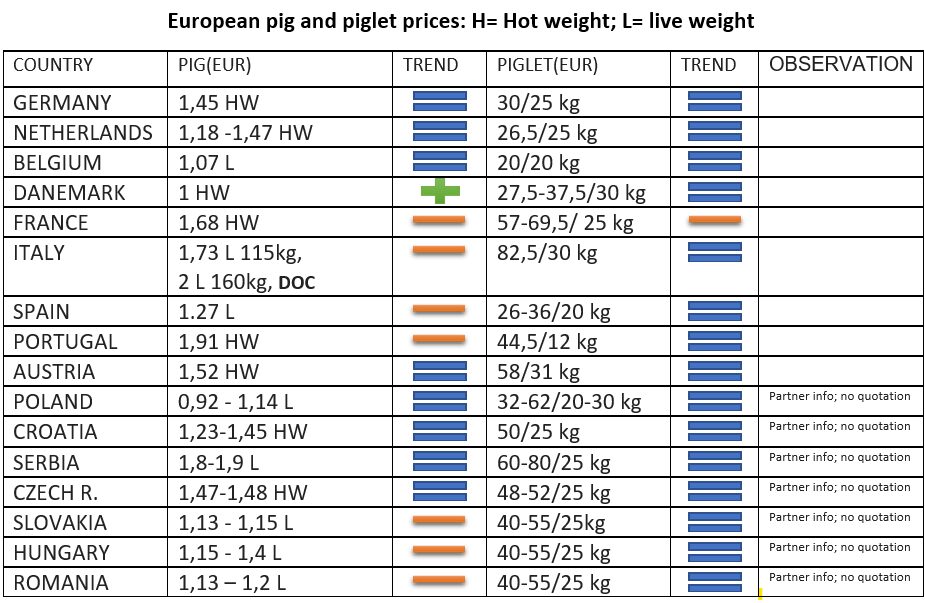
Danish Crown is increasing the price by 60 øre to DKK 7.50(approx. 1 Euro) per kilogram .The rate has been kept steady at DKK 6.90 per kilogram for a while because of financial and operational challenges at the close of the fiscal year, which ended at 30 of September. According to the management, there is now justification for the price hike, even though the market conditions are still tough and the pricing trend is persistently unfavorable.
Danish Crown is also reorganizing its structure as the Danish meat company shifts its emphasis toward Europe, intending to focus on six specific markets, streamline the number of brands it uses, and work toward a more cost-effective position within the European market .Additionally, the firm aims to boost the percentage of meat processed from its farmer-owners from approximately 25% at present to 50% by the close of 2030 .
Seven of the eight divisions within Danish Crown will be unified under a new global management framework .The affected business divisions include Sokołów, Beef, Industry, Foods, KLS, UK, and ESS-FOOD. Only DAT-Schaub, which focuses on natural casings and by-products, will continue as a separate entity .
The current leaders of these business divisions will vacate their roles .The future management team of Danish Crown will consist of five executives. Danish Crown has appointed a new chief operating officer for production and supply chain, but the company plans to reveal the identity of the new COO at a later time .The new organizational structure is expected to be fully operational by spring 2027.
I think the European pig industry is losing two giants…