Dear readers,
We share some good news for the swine industry:
- The Catalan Minister for Agriculture, Livestock, Fisheries, and Food, Òscar Ordeig, along with the Catalan Minister for the Interior and Public Security, Núria Parlon, convened with the mayors from the towns impacted by the mobility constraints linked to the African Swine Fever (ASF) Eradication Plan to declare that the initiative is now reaching its concluding phase. During this phase, there will be a significant intensification of efforts to control the wild boar population and to locate and dispose of carcasses, with a specific focus on trapping within the urban sections of the affected towns. “The objective is to completely eradicate the wild boar population in the enclosed zone by year’s end, as they may facilitate the ongoing spread of the virus,” the minister emphasized. In addition, the Catalan government revealed plans for the establishment of a collaborative group including local authorities and technical experts. The group was also made aware of the necessity to enhance monitoring to deter vandalism against the fences and trapping mechanisms. There was an additional request for increased assistance for teams conducting nighttime operations utilizing firearms .
- Beyond Meat shares fell more than 12% after the company agreed to exchange about $15 million of 2027 convertible notes for common stock at a discount to face value. Meanwhile Maple Leaf Foods, a major Canadian meat processing company, has invested more than $1 billion in plant-based proteins in the past ten years but is now reducing its production as the market for meat alternatives faces challenges. The firm announced that it will shut down its facilities for plant-based production in Seattle and Turner Falls, Massachusetts, over the next year to year and a half, streamlining operations to one plant in Indianapolis. This choice comes after a drop in the American market for plant-derived proteins, which has fallen by 21% to 35% since the year 2021, according to findings from the market research firm Mintel. Multiple reasons, such as elevated costs in comparison to animal-derived proteins and worries regarding the ingredients, have adversely affected the sales of plant-based items. The fake meat hype is over…
Events calendar:
- The “Espacio Food & Service” is a leading trade fair in Chile’s food industry and a central meeting point for industry experts from across Latin America. The fair takes place for the 14th time on 3 days from Tue., 29.09.2026 to Thur., 01.10.2026 in Santiago.
- The Anuga Select India is a prestigious international trade fair and conference for the food and beverage industry. The fair will take place on 3 days from Tuesday, 29. September to Thursday, 01. October 2026 in Mumbai.
Opportunities
USDA reported a total of 74.3 million pigs and hogs as of September 1, marking a decrease of 2% compared to the previous year .This decline is more significant than the “slightly below” anticipated by analysts .The number of market hogs decreased by 1.5% to reach 68.4 million, while the breeding population decreased by 1% to 5.875 million, the lowest size of the breeding population since September 2013 .
Meanwhile, on our European home ground Denmark imposed an immediate 12-month freeze on permits for new or expanded conventional pig barns, with organic and free-range farms exempt. Also, the number of slaughterings in the Netherlands has fallen sharply by 5.9 percent, given the enthusiasm among pig farmers to participate in the buyback schemes.
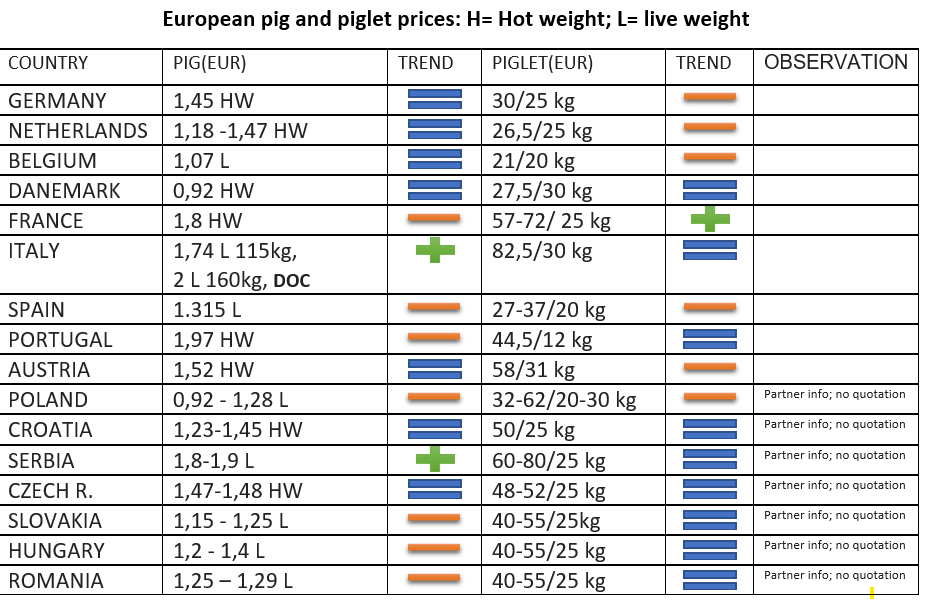
Most of the national quotations in Europe are still following the German one. The recent decline in prices for German pigs has taken the industry by surprise .Major meat companies are now raising concerns. The sector as undergoing a significant, structural shift: many individuals, ranging from farmers to sausage makers, are currently experiencing financial losses. German pig farmers are claiming losses nearing €50 million weekly, as stated by German industry associations .The prevailing prices fail to meet the production expenses for piglets and fattened pigs, which would need to exceed €2 for each kilogram of carcass weight .The deficit amounts to around €55 per pig, amidst weak demand, excessive supply within the EU, and escalating costs overall. This assessment is based on nearly 900,000 pigs being processed each week in Germany at abattoirs that must register with the Federal Office for Agriculture and Food (BLE), those at unregistered abattoirs, and overweight pigs .
What about the retail?
At this time, the financial reports of the Lidl Foundation Group for the year 2025/26 clearly indicate that there has been another rise in net earnings .Specifically, it surged by 400 million euros to reach a total of 2.7 billion euros .This financial document probably fails to fully disclose the retailer’s actual capacity for generating profit .
In the past few years, the food retail industry has consistently highlighted the significance of meat sourced from animal welfare-certified higher husbandry systems (HF) 3 and 4. Since 2024, Edeka Nordbayern-Sachsen-Thüringen (NST) has engaged nine piglet producers and 18 fattening farms, ensuring they receive prices that reflect their total costs .
At the beginning of June Edeka NST ended its fixed-price agreements with piglet producers and provided fatteners with the choice to transition to a premium pricing model ahead of schedule .The company pointed to poor sales and revenue results for its “Farmer’s Treasures” pork from husbandry system 3 as the main reason. Some farmers have declined the early transition and have chosen to maintain their current price-related contracts. Numerous contracts still had multiple years left on them and some farms had made substantial investments in new barns that prioritize animal welfare based on these agreements and had tailored their financing to reflect those investments. Edeka NST now seems to be planning to end current contracts prematurely, according to the German Pig Producers’ Association (ISN). So, is the increased animal welfare requirement really coming from the consumers?
The Philippines and the European Union reached an important accord during their talks concerning a Free Trade Agreement (FTA). Both sides will now endeavor to finalize the negotiations, focusing on technical details and frameworks for implementation. Commission sources have indicated that there will be anticipated tariff reductions for the pork sector and will ease market access for products like mechanically separated poultry, beef, dairy goods, olive oil, wine, and alcoholic drinks.
From January to August, the Philippines registered a 7.6% rise in meat imports: pork imports escalated by 5.16%, hitting 602,655 tons, whereas beef imports saw a drop of 5.2% .Brazil remained the top supplier of beef, chicken, and pork. USDA forecasts that the Philippines will boost pork imports by 7% to around 835,000 tons by 2027, due to the persistently slow recovery in local production that does not meet the strong demand .This projection is about 55,000 tons more than the adjusted estimate for 2026, which is 780,000 tons, mainly influenced by a population that is expected to reach 114.6 million the following year.
Is this trade agreement giving to the EU pork enough opportunities?