Dear readers,
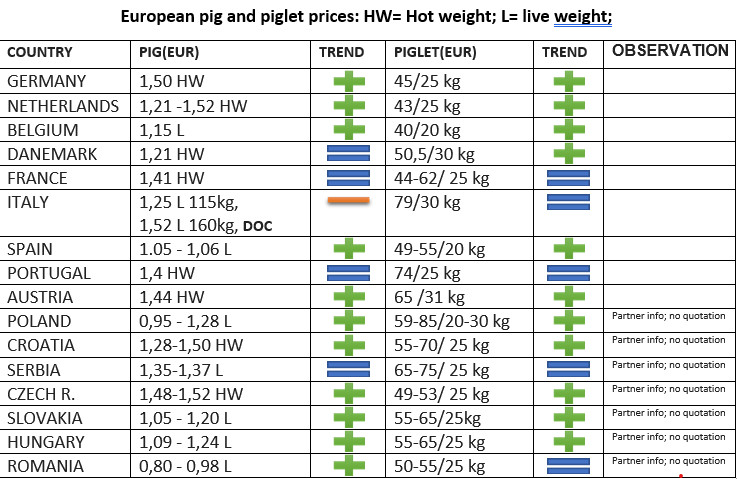
Prices start to increase in most of the monitored markets, we also have some other good news :
- Smithfield Foods initiated the approval process to build a new packaged meats and fresh pork processing facility in Sioux Falls, South Dakota, a project that could total up to $1.3 billion over the next three years. The facility would replace Smithfield’s existing downtown plant, which has operated for more than 100 years. Smithfield currently employs about 3,200 people in Sioux Falls, providing $200 million in annual wages and supporting thousands of indirect jobs tied to the regional pork supply chain. “This highly automated facility will represent a major investment in Sioux Falls, the state of South Dakota and the future of American agriculture,” said Shane Smith, president and CEO of Smithfield Foods. “Smithfield’s investment supports our long-term strategy of continuing to grow and optimize our value-added packaged meats and fresh pork operations to deliver innovation, convenience and value to our customers.”
- In 2025, the EU-27 states boosted their pig and pork shipments in relation to the year before. There was an approximate rise of 2. 1% in pork exports to non-EU nations compared to 2024.The overall volume of exports reached 4. 2 million tons. Spain emerged as the foremost exporter in Europe, holding nearly a thirty percent share of the market. In comparison to the previous year, Spanish exports saw a growth of 1. 6%.
- In Spain the Burgos City Council has given the green light to the Campofrío Group’s expansion plans after granting new building permits. The company has already invested €1.4 million in a new slicing facility at its subsidiary, Carnes Selectas.
Events calendar:
- The RegioAgrar Bayern, a leading regional agricultural fair, takes place in Augsburg, Germany, and is considered a significant industry meeting point in the region. The fair will take place on 3 days from Tuesday, 24. February to Thursday, 26. February 2026.
- The “New York Farm Show“, held annually at the New York State Fairground in Syracuse, has become a crucial hub for experts in agriculture and forestry. The Show will take place on 3 days from Thursday, 26. February to Saturday, 28. February 2026.
Amsterdam
Participants of the Mercolleida Fattened Pig Price Board, which consists of 16 leading firms within the Spanish pork industry, conveyed their “significant worry” last week regarding the handling of the African swine fever (ASF) outbreak in Catalonia. According to their press release: “It is the livestock farmers throughout Spain who are already paying the price for African swine fever (ASF), but what we must avoid is a German-style situation in Spain: Germany has been fighting ASF for five and a half years now, which demonstrates the complexity of managing this disease if it is not tackled at its root, by addressing its main vector of transmission, which is wild boar.”
Germany’s pig production has been strongly reduced in this period. Even with approximately 20% less pigs, the loss of some Asian markets put a challenge on the sales of pork. Slaughterhouse closures increased the efficiency of the remaining ones, but short working weeks during the holidays determined a surplus of pigs on the market. This offered the opportunity to the slaughterhouses to reduce the quotation until the surplus is driven out of the market. With over 730.000 pig slaughtered the week before, the highest number in the recent period, now the pressure is over, and the increase of the German quotation is a clear sign of it.
In Spain, there is an observable, modest but meaningful recovery in the market; following two months of pressure on the producers, processors are beginning to aim for securing their supplies. Average weights have seen a minor reduction of 0. 5 kg in just two weeks, yet they still exceed last year’s levels by 1. 4 kg. The number of slaughtered animals has hit unprecedented highs, being 8 to 9 percent greater than in 2025. For the first time in eight months, prices have increased by 1. 5 cents two weeks ago and another 5 cents last week. Notably, Spanish pork is still the most affordable globally, underpricing that of Germany, the Netherlands, and Denmark.
In Belgium, the average weight continues to drop significantly, averaging a decline of 530g each week, and the activity level is up by 4 percent compared to last year.
Over the span of ten years, the swine industry of the Netherlands is anticipated to generate 30% fewer pigs. This includes the overall count of pigs for export, piglets that are exported, and piglets intended for domestic use and slaughter. In 2020, this figure amounted to 24. 07 million pigs. By the year 2030, this figure is projected to decline to 17. 16 million pigs. The projection reflects the anticipated trends in Dutch pig production, informed by the evolution of output, exports, and data from Central Bureau of Statistics.
In 2030, there will be an estimated 520,000 sows, compared to over 920.000 in 2020.
Do you remember the loud minority of animal rights activists? Well, they have new ideas in the Netherlands!
By 2027, a required weaning age of no less than 8 weeks for piglets in newly constructed barns should be implemented, and by 2030, this weaning age should also apply to all current barns. The “Pigs in Need” organization advocates for this change in their publication “Growing Up Without a Mother. “In the Netherlands, piglets are currently weaned at around 3 to 4 weeks old.” Pigs in Need” highlights that this premature weaning significantly deviates from the natural instincts of pigs. In a natural environment, piglets typically gain independence after a minimum of 8 weeks, and often around 15 weeks on average. The organization contends that this early separation is mainly driven by economic factors, resulting in considerable distress for the animals. It references research from authoritative organizations like the European Food Safety Authority (EFSA) and Wageningen University & Research (WUR), which report that separating piglets from their mothers at an early age leads to “great distress. ” Reportedly, piglets experience numerous sudden and significant alterations simultaneously: losing their mother, moving to a new environment, facing new cage companions, and switching to solid food. This leads to feelings of fear, anxiety, hunger and thirst, abnormal behaviors, and a heightened vulnerability to illness.
As the European society is evolving today, we should keep our eyes on Amsterdam!