Dear readers,
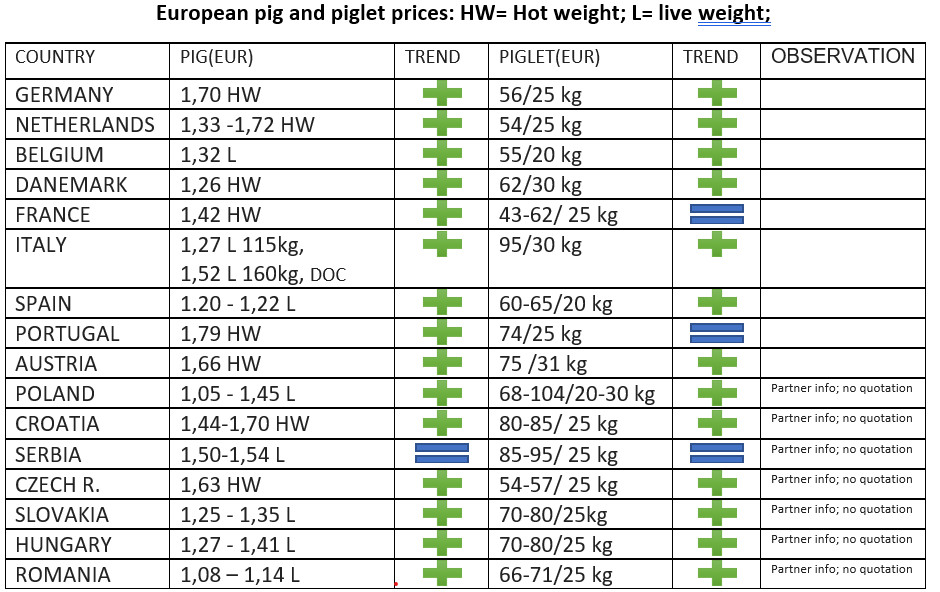
Prices continue to rise and we have some more good news from the swine industry:
- The Brazilian cooperative Aurora has revealed intentions to allocate 200 million euros for the upgrade and expansion of its pig farming operations. A major undertaking involves the establishment of a new slaughterhouse , designed to ultimately take the place of the current one, is expected to represent around half of the overall investment. At present, the slaughterhouse in São Miguel do Oeste manages the processing of roughly 2,000 pigs daily. The anticipated new facility is expected to boost this capacity to about 5,000 animals a day by the latter half of 2027.
- Quiano Foods is the updated title for Jamones Arroyo, a company situated in Ciudad Real, Spain, which Jamones Ancín has taken a controlling interest in. An investment totaling €8 million will be allocated to its sites to establish a new line for ham deboning and slicing.
- Pilgrim’s Europe has initiated a Butchery Academy aimed at recruiting new talent into the UK meat sector. This academy provides paid instruction, accredited certifications, and enduring career possibilities for individuals aspiring to acquire specialized butchery skills. Aspiring butchers receive top-quality instruction through a mixture of theoretical classes and practical training alongside seasoned teams on-site. Those who successfully complete the training will achieve the status of Grade 2 Butcher within 12 weeks, earning a competitive salary while undergoing training. The company is also providing continuous development opportunities for those who wish to advance their careers to Grade 1.
- The OSI Group from the United States is interested in purchasing the Vion slaughterhouses located in Southern Germany. Additionally, it is said that the OSI Group is exploring the option of acquiring a slaughterhouse situated in Traunstein, Bavaria. Vion has expressed a longstanding intention to sell its slaughtering facilities in Southern Germany. The purchase of the German Vion slaughterhouses by Tönnies (Premium Food Group) was officially canceled in November 2025, after the German Bundeskartellamt blocked the transaction due to concerns over potentially excessive market dominance. Following this, Tönnies stepped back from pursuing the properties after a preliminary agreement in 2024 had already fallen apart. Westfleisch also displayed interest, but this acquisition is currently not proceeding.
Events calendar:
- The “Prager Karlsbörse” is a trade fair in the food and agricultural sector, held at the Cubex Centrum Praha, Czech Republic. As the largest trade fair of its kind in Eastern Europe, it attracts professionals from various fields such as traders, cooperatives, analysts, and producers. The fair will take place on 2 days from Wednesday, 18. March to Thursday, 19. March 2026
- The Alimentaria Barcelona, one of the world’s largest trade fairs for food and beverages, serves as a central meeting point for leading manufacturers and suppliers in the industry. This event, held at Fira de Barcelona, will take place on 4 days from Monday, 23. March to Thursday, 26. March 2026. See you there!
Just for fun:
- A wild boar entered a Berlin shopping mall’s home decor shop, causing staff to flee and prompting a police response on March 13.Authorities, including zoo staff, considered sedation but opted to guide the boar out using wooden pallets towards a nearby forest. This incident isn’t isolated; in 2023, a boar caused panic in Berlin after being confused with a lioness, highlighting boars in urban areas.
Green, green
Do you remember our “friend”, the former vegan-muslim German agriculture minister? Green Party politician Cem Özdemir secured a historic victory in the state elections in Baden-Württemberg. This achievement puts him in position to become Germany’s first state premier of Turkish descent. Although the Greens lost ground nationally, Özdemir managed to attract centrist voters with a “business-friendly” profile, emphasizing the region’s economic competitiveness.
Meanwhile in the neighboring Denmark the Danish Social Liberal Party (De Radikale) has proposed reducing Denmark’s pig production by 50% within ten years, citing poor welfare conditions. The Party is campaigning to ban the construction of new pig farms and the expansion of existing ones, arguing the environment cannot handle further agricultural emissions. Animal welfare and pig production are key topics in the 2026 election cycle, with environmental groups and political parties putting significant pressure on the industry.
In 2024, Denmark exported pigs worth 1,51 billion € , making it the largest exporter of Pigs (out of 57) in the world. During the same year, pigs were the 10th most exported product (out of 1,217) in Denmark. The main destinations of Denmark’s pig exports: Poland, Germany , Italy, Netherlands and Spain, totaling over 14 million piglets, pigs and breeding animals.
How will the European pig production map look like, if Germany and Denmark go green, green?!