Dear readers,
Lets see some good things happening in the swine industry:
- The choice made by the Spanish Coexca S.A. and Comafri S.A is to establish a collaborative agreement aimed at unifying their production activities. This union proposes the combination of the pork processing facilities of both firms, situated in Maule and Rancagua, by setting up a new company that will oversee the resources of both plants .Additionally, it involves the creation of another entity focused on the collective marketing of pork cuts and related products .
- The Governing Council of the Andalusian Regional Government has received updates regarding the forthcoming opportunity for applying for financial assistance from the Ministry of Agriculture, Fisheries, Water, and Rural Development dedicated to Livestock Health Defense Groups (ADSG) .With a budget allocation of €3.2 million for the fiscal year 2026, these grants are included in the Strategic Plan for the Common Agricultural Policy (PEPAC) for the years 2023 to 2027 and are partially funded by the European Union via the European Agricultural Fund for Rural Development (EAFRD), along with contributions from the Spanish State and the Andalusian Regional Government .These financial aids are designed to encourage professional consulting for proprietors of cattle, sheep, goats, pigs, poultry, and aquaculture operations
- The Spanish Ministry of Agriculture, Fisheries and Food (MAPA) has announced that there has been more advancement in the reopening of global markets for Spanish pork products that have been impacted by restrictions related to African Swine Fever (ASF). A key milestone is the agreement made with Honduras to restart pork exports from regions unaffected by the disease .Regarding Ecuador, MAPA has indicated that a new health certificate for exporting processed pork products has been agreed upon and is now in place .On the other hand, Ukraine has accepted regionalization following European guidelines, allowing fresh Spanish pork access under stringent sanitary protocols .
- The Honduran Ministry of Agriculture and Livestock, in collaboration with the National Service for Agrifood Health and Safety and the National Association of Pig Farmers of Honduras , has entered into a technical-financial agreement worth roughly 825,000 euros, aimed at enhancing swine epidemiological monitoring and progressing toward achieving international acknowledgment of the country as free from Classical Swine Fever (CSF) .
Events calendar:
- The India HoReCa Expo is a leading trade fair for the hotel, restaurant, and catering industry, organized by Synergy Exposures & Events India Pvt. Ltd. The exhibition will take place on 3 days from Wednesday, 01. July to Friday, 03. July 2026 in Bangalore.
Delightful Philippines
Meanwhile some major pig producer countries are downsizing their production, mostly due to new political approaches.
In the German state of North Rhine-Westphalia, 77% of producers of piglets have filed a building application or conversion plan for the essential alterations needed in their breeding or farrowing facilities .Six percent of these farms plan to stop production by the deadline of February 2029 and will not pursue any conversions .Additionally, 17% have yet to submit a conversion plan .For most of these establishments, this situation will probably lead to the conclusion that piglet production in just over two and a half years .The information has been provided at the general assembly of the Westphalia Producers’ Association held in Davensberg.
Rather than sending millions of piglets to Germany or Poland for fattening, the Danish government intends for these animals to primarily be fattened, processed, and slaughtered within Denmark .This strategy aims to preserve jobs within domestic slaughterhouses and processing facilities.
A temporary prohibition on building new conventional pig barns and expanding current farms is set to be applied. A CO2 tax specifically targeting livestock farming is expected to be introduced. The government also intends to significantly tighten animal welfare regulations, which may inadvertently affect exports .By 2030, a full ban on tail docking will be enforced .Additionally, the government plans to entirely eliminate the confinement of sows in farrowing areas, establish a minimum weaning period of four weeks, and require considerably more space in the pens .
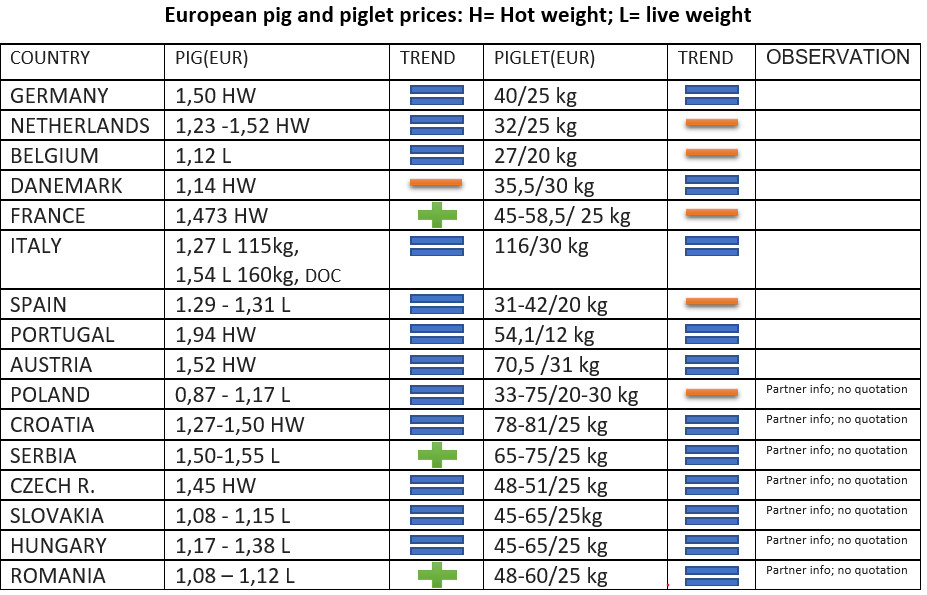
At present, approximately 7.3 million piglets are shipped to Germany and 7.8 million to Poland .The collapse of these export markets, without the ability to fatten the animals profitably inside Denmark, would spell the end for numerous Danish farms. Maybe the actual pig carcass quotation of 1,14 €/kg will encourage the farmers to work with the Danish slaughterhouses…
Vietnam and the Philippines are struggling with the African swine fever (ASF) in the last years.
Vietnam was the first country to license ASF vaccines, but the current epidemiological situation does not show that vaccination -for whatever reason- is efficient.
The Philippines issued import licenses to solve the pork demand. This year many countries got licenses to supply one of the best pork belly markets and aree competing pricewise to fill the demand.
In April 2026, CAVAC, a corporation from South Korea, received authorization to export its newly developed vaccine for ASF, branded as Suishot ASF-X . CAVAC created this vaccine using a live cell-adapted strain, ASFv-MEC-01, derived from a naturally weakened form of the virus found in wild boar populations in South Korea. The initial launch of this vaccine is anticipated to occur in the Philippines and Vietnam. Research conducted in Vietnam has shown that there was complete seroconversion in young piglets after they received colostrum from vaccinated sows, no major side effects after the vaccination of pigs at six weeks of age, and all vaccinated animals survived after exposure to the genotype II ASF virus, while all animals in the control group perished. We wait more good news from the delightful Philippines.