Dear readers,
For the beginning, the good news from the swine industry:
- The Seychelles has removed the prohibition on importing pork from Belgium .As a result, this island country is the final major nation to eliminate trade limitations put in place during the African swine fever(ASF) incidents in Belgium .The Belgian government states that this marks the conclusive end of a situation that started with ASF outbreaks in 2018 and 2019 .The restriction was enacted after ASF was found in wild hogs in Belgium .Even though Belgium has been free from the illness for a considerable period, several countries continued to enforce their import restrictions .The Seychelles has now decided to lift that restriction.
- The World Organization for Animal Health (WOAH) has released a useful guideline for nations looking to implement vaccines to combat African swine fever (ASF) .This document aims to assist governments in evaluating vaccines in practical settings and tracking their impact after they are rolled out .The updated guideline provides suggestions for various aspects, including the setup of field trials, evaluating the benefits versus risks of a vaccination initiative, and observing effectiveness along with possible adverse effects post-introduction .It also offers practical resources, like forms for data gathering and templates for field research design. This guideline caters to veterinary officials and other organizations that are contemplating the initiation of a vaccination campaign .WOAH stresses that solely relying on laboratory studies is inadequate .Before a vaccine can be widely applied, its safety and efficacy should be confirmed in authentic scenarios. Furthermore, WOAH states that vaccination should not be implemented in isolation .The organization emphasizes that biosecurity measures, monitoring, and transport protocols are critical elements in the battle against African swine fever .They also recommend that nations utilize only those vaccines that comply with the international quality standards set the previous year .
- The Maschhoffs have commenced construction on the latest addition to their production facilities, named Gray Rock, situated near Eldorado in Gallatin County, Illinois, within the scope of the company’s Great South Region. In their announcement of this achievement, The Maschhoffs conveyed that construction has started, and efforts to hire staff are already in progress, which includes the recruitment of a Farm Manager to oversee operations at the new facility. Although specifics regarding the site’s capacity and production schedules have not been disclosed at this time, this project demonstrates a sustained belief in the future prospects of U.S. pork production and highlights the significance of targeted investments in contemporary swine operations .
- The Brazilian cooperative organization Aurora Coop is set to officially open the expanded Frigorífico Aurora São Gabriel do Oeste pork slaughterhouse, after making an investment of around €56.7 million. Situated in Mato Grosso do Sul, the facility will rank among the largest pork processing plants in the central-western region of Brazil, generating 950 jobs .The capacity for slaughtering will rise by 60%, increasing from 3,200 pigs per day to 5,000 pigs per day .
Strongest
The Netherlands shipped out 2,410,684 piglets during the first half of 2026 .This figure represents a decline of 20.9 % compared to the same timeframe in 2025.It marks the smallest total in the last decade and highlights the ongoing decline in the Dutch pig industry over recent years, following a peak year in 2018 with 3,630,258 animals exported.
Spain continues to be the primary destination for Dutch piglets, a status it achieved for the first time in 2025 by surpassing Germany. During the initial half of the year, 1,057,586 piglets were received from the Netherlands, reflecting a drop of 30.2 percent compared to 1,514,183 piglets imported during the same period the previous year .Germany placed second, importing 1,039,074 piglets, which is an 11 percent decrease compared to 2015. Collectively, these two nations represent 87 percent of all piglet exports from the Netherlands, a significant shift from ten years ago: in the first half of 2016, Germany almost completely dominated the market with 2,279,677 piglets (accounting for 68 percent of the total), while Spain only imported 114,111 piglets.
Romania recorded the most significant drop among traditional markets, falling from 62,226 piglets in the first half of 2025 to merely 11,036 in 2026, a reduction of 82 percent.
Germany, as a piglet buyer, is declining. The reason? “ITW” (Integrated Animal Welfare requirements.
Currently, there are more than 22 million pigs categorized as “ITW”. The challenge stems from consumers .They are not showing the anticipated demand for animal welfare products .A new market framework will be implemented starting January 2027 .After this point, incentives will hinge on market dynamics, and retailers will apply price pressure during tough times .The retail industry will capitalize on its chances and will be unyielding regarding financial matters .The ITW (Institute for Animal Welfare) has successfully added nearly 7 million new piglets in its most recent registration round .Even those who were the most hopeful did not foresee this outcome .Mathematically, the previously existing piglet deficit has now been mitigated .
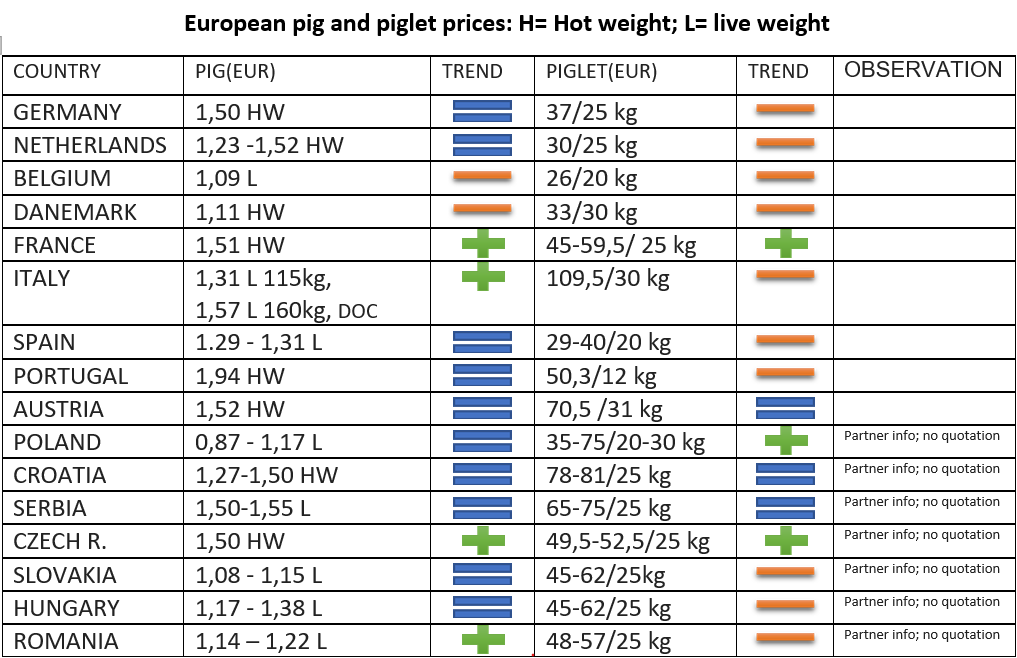
Danmark and the Netherlands are loosing their main piglet buyers, leaving an excess of millions of piglets/pigs on the national market. Not to much place and feed to raise them and no good quotations in the local slaughterhouses. Who will survive: the strongest!