Dear readers,
We still find some good news for you:
- The Scottish administration has announced a £2 million initiative to assist independent pig farmers in Scotland to tackle the ongoing issue of low prices they have been facing. According to the government, the funds are intended to aid farms that are particularly vulnerable due to a sustained decline in pig prices, putting their operations and the future of the Prime Scottish Pork label at risk. The program will launch on July 15, with support retroactively applicable to losses experienced since March, and it is expected to run until August 2026 .Qualified farmers can claim the shortfall between the amount they received for their pigs and 85% of the Standard Pig Price (SPP). Those producers who are under the same ownership as the abattoir operators will be excluded from eligibility. Since the beginning of the year, Scotland has seen a loss of roughly 15% of sows in the independent farming sector, and four producers have already left the industry.
- The European Commission has a new livestock industry strategy. The Commission highlights that animal husbandry represents around 40% of the value added to agriculture in the EU, results in nearly €400 billion in yearly revenue, and creates about 7 million jobs across 4 million farms .However, this industry is currently experiencing decreasing profit margins, elevated production expenses, health issues among animals, changes in climate, and growing regulatory demands .The strategy is structured around five key components: enhancing the resilience of the sector, boosting competitiveness on farms, fostering sustainable production, preserving livestock farming in various regions, and supporting European food initiatives .At the same time, the Commission has introduced a Protein Action Plan, which aims to raise the EU’s self-sufficiency in the production of feed protein from 25% to 35% by the year 2035.
Events calendar:
- The 2026 Swine Industry Environmental Forum will hold its 5th edition on July 15, 2026 in El Salto, Jalisco, Mexico. Organized by Evobac and the Jalisco Regional Swine Producers Union, it is the key meeting place where production and sustainability converge The event takes place from 9:00 a.m. to 5:15 p.m. at Carretera a Penwault #148, Col. El Castillo. It addresses critical issues for mitigating the environmental impact of intensive pig farming, such as soil, water, and air degradation, and presents waste management alternatives and new technologies.
The Letter
Italian scientists have pinpointed the key elements that led to the emergence of African swine fever (ASF) in pig farms across northern Italy throughout 2024 .The primary risk factors identified include human interactions, the movement of vehicles, and inadequate division between living spaces and production zones, while rigorous biosecurity protocols were shown to considerably lessen the chances of contamination .These results were shared by experts from the Experimental Zooprophylactic Institute of Lombardy and Emilia-Romagna at the European Symposium of Porcine Health Management that took place in Florence in May 2026.
The research group investigated ASF incidents on 16 pig farms in the Lombardy area that were affected in 2024 .For accurate comparison, each infected farm was paired with two analogous ASF-negative farms situated within a 20-kilometre distance .In total, 48 farms were assessed using a specialized questionnaire that addressed 69 possible ASF risk elements and biosecurity strategies .The most critical risk factors included:
• the owners, family members, or employees of the farm having interactions with other pig farms;
• external personnel visiting the clean production area of the farm;
• the transportation of manure to storage sites using vehicles;
• the farmhouse being positioned within the confines of the farm, leading to inadequate separation between residential and production functions.
As long as we do not really see reports of how a farm got contaminated with ASF, the study offers some responses.
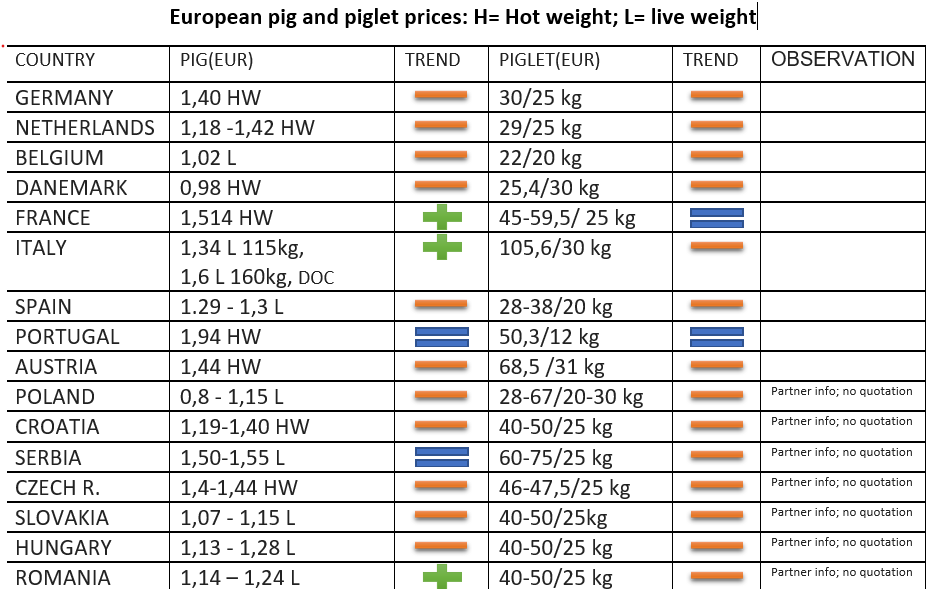
Three years ago, Dutch hog farmers were encouraged to participate in the “Varken op z’n Best”(VOB) of the Van Rooi slaughterhouse .The pricing structure was designed to stabilize the fluctuating pig market and provide business owners with the confidence needed to invest in better animal welfare practices .Now, as the market encounters challenges, meat processor Van Rooi is altering the established terms. Hog farmers supplying Van Rooi through the VOB initiative will receive a different payment for their pigs .Previously, the payments were calculated at 50 percent market price and 50 percent cost price .This will change to 62.9 percent market price and 37.1 percent cost price .Van Rooi explains that there has been a consistent discrepancy between supply and demand observed lately .There are insufficient purchasers for VOB meat .The slaughterhouse notified the participating hog farmers about this via a letter .The adjustment in pricing became effective on July 1.
In Germany, the Westfleisch slaughterhouse also announced a modified pricing system, valid from 08.07.2026. The new price, paid to the supplying farmers, will deduct 2 cents from the German quotation, as it is not low enough…It is even more strange to proceed like this, as long as Westfleisch is a cooperative.
The slaughterhouses claim and develop “in sickness and health” cooperation models when the hog price increases and organize events to promote the programs. When sickness hits the farmers, slaughterhouses send out letters…