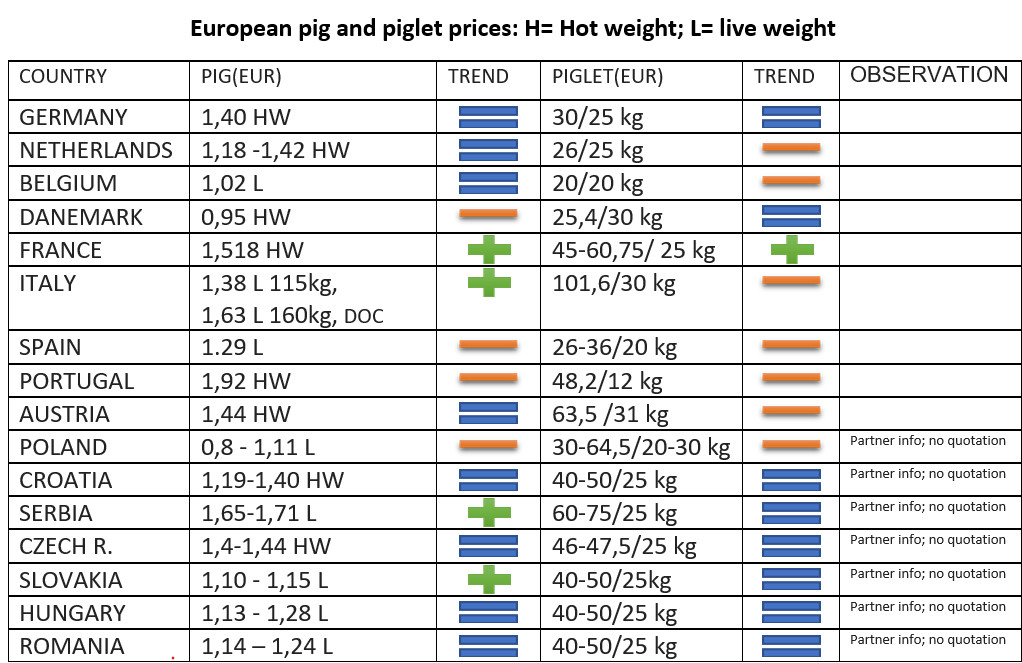
Dear readers,
Some good news from the swine industry:
- In the U.K., Cranswick has formed a strategic alliance with The Jolly Hog, recognized for its acclaimed range of high-welfare sausages .This collaboration involves funding from Cranswick, which will offer the ‘know-how, resources, and additional financial input’ necessary to expand the brand on a national scale. Established in 2007, The Jolly Hog has made a name for itself as a “rapidly expanding alternative brand focused on outstanding flavors, high quality, and a dedication to better welfare for British pork.” This partnership will facilitate the ongoing growth of The Jolly Hog’s award-winning primary product line, aiding the company in satisfying rising demand and enhancing product availability in the retail sector.
- Swine Innovation Porc, Prairie Swine Centre, the Centre de développement du porc du Québec, and the Canadian Centre for Swine Improvement are introducing the Pork Research Hub, a nationwide platform that links Canada’s pork industry with research, innovation, and experiential knowledge. The Pork Research Hub brings together research papers, technical materials, videos, webinars, podcasts, and stories of innovation from Canada’s swine research community into one easily navigable, bilingual platform. Aimed at assisting farmers, researchers, industry leaders, and partners throughout the value chain, the hub enhances access to Canadian pork research and simplifies the process of locating useful information that can aid in decision-making and the transfer of knowledge. The platform is structured around two main areas: the Resource Library, which is a searchable collection of research papers, factsheets, tools, and technical information, and Research in Action, a selected section that showcases the practical effects of Canadian pork research via articles, videos, podcasts, webinars, and innovation narratives .
Events calendar:
- The 58th National Congress of the Mexican Association of Swine Veterinarians (AMVEC) invites you to join the leading community in animal health and agricultural development. This year, we will celebrate innovative advances in swine breeding, with a focus on sustainability, technology, and animal welfare. The location is 3C FORUM, Special Development Workshops FFCC, 20180 Aguascalientes, AGU Mexico, from July 21st to 24th.
More and More
Asia is the main targeted market for the European pig producers. While most of the countries of the region are consuming pork, the local production is under permanent threat of the African Swine Fever(ASF) and other economically harmful diseases. How does a disease enter in a country? News are giving hints.
Livestock farmers in Cambodia have expressed their support for the government’s increased initiatives in the border areas aimed at reducing illegal entry of live swine, frozen meats, and poultry eggs, stating that enhanced regulation will benefit local farmers, safeguard animal health, and foster investment within the national livestock industry.
Taiwan’s National Immigration Agency has advised tourists against transporting pork or any meat items from regions impacted by ASF during the summer vacation period to maintain the island’s disease-free condition .Last year, 542 visitors were penalized with fines of USD 6,150 each for unlawfully carrying pork items.
Europe benefited from this condition for close to two decades, as long as the main pig producing countries maintained their ASF free status.
The first large producer to be affected by the disease and its effects to international trade was Germany. At least, in this case, we seem to know the way that the ASF entered in the country.
Spain benefited from the lost ASF free status of Germany, taking over the leading position in the European pig production, as well as the foreign markets of the German pork. Now Spain is also hit by ASF, loosing exports markets and, at least for now, we don’t know how they got infected.
The next leader to step up? It should be Denmark.
Danish pig farming transitioned from small-scale family farms to large-scale, highly focused operations that generate over 30 million piglets each year .In spite of new rigorous laws regarding the environment and climate, Denmark continues to be a leading exporter of pork worldwide, bolstered by a deep-rooted tradition of cooperatives run by farmers. Farms expanded significantly in size and specialization .Rather than managing all aspects of pig farming on a single farm, some operations focused exclusively on breeding sows, while others dedicated themselves to fattening piglets .This specialization has led to remarkable efficiencies among farmers .Currently, an average Danish sow yields more than 33 piglets each year, ranking them among the most productive in the globe.Given that the domestic market is relatively small, approximately 90% of the pork produced is exported to over 120 nations .Additionally, the country sends millions of live piglets to neighboring European countries such as Germany and Poland for further fattening.
While the sow population decreased approximately 30% in the last two decades, the genetic progress and the feeding and housing improvement ended up providing the same number of market hogs and piglets. The current situation is pushing Danish Crown to postpone the slaughtering of over 200.000 pigs weekly, due to the lack of capacity.
Have you been in Denmark? Did you visit pig farms? While the industry is confident of the biosecurity measures taken, there are almost no farms with fencing and hygiene equipments at the level of countries already infected with ASF.
Where will this take the Danish pig industry, as long as they produce more and more?!